
Why the “Community Good” Status Matters in JPool

When most people choose a validator for staking SOL, they usually look at familiar metrics: APY, uptime, commission, and total stake. And that makes sense.
But recently, another factor has started becoming increasingly important within the Solana ecosystem, something that is much harder to measure with numbers alone: what a validator actually contributes to the ecosystem beyond simply running a node.
That is exactly why JPool created a separate category called Community Good Validators.
At first glance, it may look like just another badge in a validator list.
But in reality, this designation is backed by an entire delegation strategy.
What “Community Good” Means in Jpool
Within JPool, Community Good is not simply a “list of good validators.”
It is a dedicated part of the protocol’s delegation model.
JPool allocates stake specifically to operators who:
- create ecosystem value
- support decentralization
- contribute to the community
- or help develop the educational layer of Solana
In other words, the evaluation goes beyond uptime, performance, and technical reliability.
It also considers the validator’s broader ecosystem impact.
Why Running a Stable Node Is No Longer Enough
A few years ago, simply operating a stable validator was already considered a major advantage.
Today, the situation is different.
The Solana ecosystem has grown significantly. And with that growth came a new expectation: not just infrastructure, but ecosystem support.
Modern validators are increasingly becoming:
- educational resources
- community hubs
- ecosystem participants
- and infrastructure operators at the same time
Educational Content Has Become Part of the Staking Ecosystem
A few years ago, educational content was barely associated with staking.
Today, new users want to understand:
- how staking works
- where APY comes from
- why APY differs across platforms
- how liquid staking works
- what MEV rewards are
- and how to choose a validator
Without proper explanations, users often:
- pick validators randomly
- chase inflated APY numbers
- or avoid staking entirely because the ecosystem feels too complicated
That is why educational content has gradually become part of Solana’s infrastructure layer.
“Community Good delegation is a way to support operators who actively grow the Solana ecosystem and help bring new users into staking.”
Vladika Validator team
What Counts as Ecosystem Contribution
Within JPool, Community Good contribution is not limited to a single type of activity.
A validator’s impact score may include:
- educational articles
- staking guides
- calculators and tools
- media coverage
- open-source contributions
- developer support
- community engagement
- or promoting liquid staking adoption
In other words, the evaluation focuses not only on the validator node itself, but also on the ecosystem activity surrounding it.
Table: Regular Validator vs Community Good Validator
| Criteria | Regular Validator | Community Good Validator |
| Validator operations | Yes | Yes |
| Uptime & performance | Yes | Yes |
| Educational content | Optional | Often actively developed |
| Community engagement | Minimal | Active |
| Ecosystem contribution | Limited | One of the key factors |
| Support for decentralization | Not always | Often part of the strategy |
| Staking tools / calculators | Rare | Frequently developed |
What This Looks Like in Practice
A new type of validator is gradually emerging within Solana.
These are operators who simultaneously:
- maintain infrastructure
- create educational content
- write staking guides
- explain validator metrics
- build calculators
- help new users
- and engage with the community on X, Discord, and LinkedIn
Community Good score reflects not only technical reliability, but also overall ecosystem contribution.
This approach is gradually becoming a new standard for long-term trust within staking.
Table: What the Community Good Approach Brings to the Ecosystem
| Who Benefits | What It Provides |
| New users | More educational resources and easier onboarding into staking |
| Delegators | Greater transparency and more stable communication |
| Solana ecosystem | Stronger decentralization and ecosystem growth |
| Liquid staking protocols | Healthier validator distribution |
| Validators | Incentives to invest in ecosystem contribution |
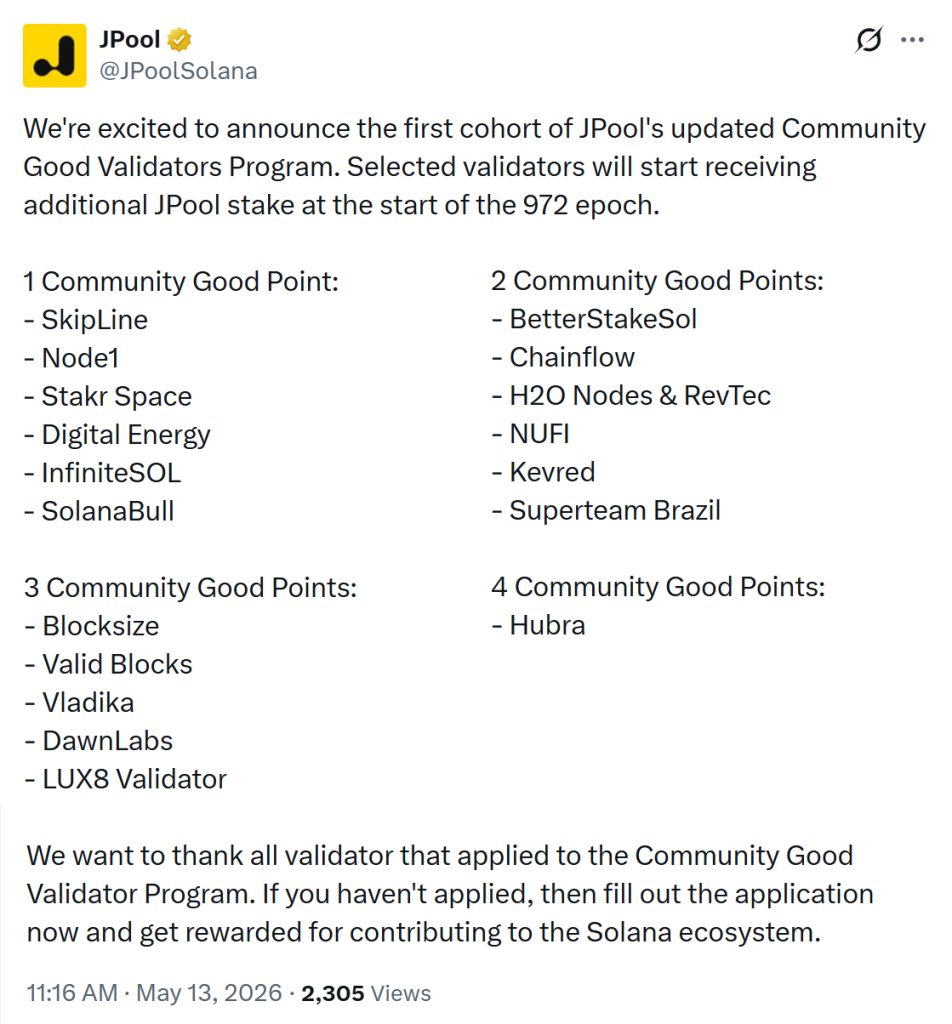
Vladika Receives Community Good Score 3
On May 13, 2026, Vladika was officially included in the first cohort of JPool Community Good Validators and received a Community Good Score 3.
This placed Vladika among only a small number of validators that received such a high score in the first cohort.
In Vladika’s case, JPool specifically highlighted:
educational staking content
ecosystem activity
community engagement
and the development of resources around Solana staking
For us, this became confirmation that ecosystem contribution is starting to play an increasingly important role in the modern staking landscape.
“We’re grateful to the JPool team for recognizing the work we’ve been putting into staking education and ecosystem growth around Solana.
For us, Vladika has always been more than just a validator node. We believe long-term trust is built through transparency, educational content, and active participation in the ecosystem.”
Vladika Validator teamAlso read: Which SOL Staking APY Should You Trust? Why We Use JPool Total APY
